Will Fraser’s first novel, Cloister, has been published in hardback, and comes out in paperback this month. I asked Will to tell me about how and why he decided to become a novelist as well as filmmaker.
Will is best known to many of us organists as as the director of award-winning documentary films about organs, organists, and organ music. These documentaries, from his company Fugue State Films, bring intelligent analysis and high-end production values to illuminate our musical world, for which we are profoundly grateful.
‘As a child I had two parallel ambitions – to be a film director and to be an organist!’ says Will. ‘I was not a chorister, but I heard the organ at Exeter Cathedral, and wanted to become a cathedral organist. My mother bought me a Helmut Walcha tape which further inspired my ambitions, but I realised that gaining FRCO by the age of 15 wasn’t going to happen, and anyway, life took me in different directions.’
Will says of his first novel: ‘This book has taken 25 years to write. It’s essentially a “coming-of-age in a cathedral” story, along with a more violent story from outside. It began as two novels, one from each of the two main characters’ perspectives – Matthew the earnest young organist, and blues singer and guitarist Chloe. But these stories were static. As soon as the dark character of Troy started wandering around the book, these two plots had to be superimposed, and things started to happen. It’s similar in a way to those 1970s Italian film thrillers, (like Don’t Look Now) where there are three elements to the plot – a naive male, a female menaced in some way, with them both being drawn into a mystery. But I’ve set this thriller in a more high-toned milieau, an English cathedral city.’
I won’t spoil it for the reader, and will leave them to unravel the dark mystery that drives the plot. But personally what I enjoyed most is Will’s spot-on skewering of the life of working musicians, particularly that of the cathedral organist.
It is notoriously difficult to write well about playing music (even harder, perhaps, than writing about sex) – to explain the near addiction that drives musicians to make music both on their own and with others. Will knows about the real inner life of musicians: the endless ‘am I any good? that they flail themselves with; the perpetual (and usually unfavourable) comparing of self with one’s peers; the utter dejection after a performance in which only a handful of people would have noticed those tiny mistakes; and the importance of the obtuse musical challenges we set ourselves (like playing the whole of The Art of Fugue from memory, as in the novel).
Both the novel’s main characters are driven, as they have to be, by their musical lives. Chloe, the blues musician, is self-possessed and far more savvy than Matthew, a painfully thin-skinned character who has sacrificed his personal development to organ practice. Living in his own own head most of the time, he is as surprised as a child when he discovers at the outset of the story that the world has moved on without him.
His self-doubt means he is unable to stand up to a bullying musical superior, and this is where Will captures perfectly the preoccupation with hierarchy and status within the cathedral music world, the professional jealousies that can flare and blight the workplace, along with the lay people with their own axes to grind: administrators, choristers, organ scholar mums, and organ builders. Apart from the story, I would recommend Cloister for the subtlety with which Will draws his secondary characters, all recognisable to anyone who’s spent any time in church music.
And all of us in the music business will have encountered at least one person like Matthew’s superior, Geraint: a prime example of a fine musician but deeply unpleasant human being. He’s succumbing to alcoholism but is still able to flash his god-given talents to frustruate and intimidate.
Will is good on the culture of refined musical sadism which can prevail at the apex of church music: Matthew suffers attempts at humiliation from his superior including casual put-downs, spiteful critiques of technique, and demands to transpose at sight into a ridiculous key. (Personal sidenote: with more and more women now taking to the cathedral organ bench, I do hope this culture of male competitiveness and point-scoring is finally disappearing.)
Will never forgot his early ambitions and the Helmut Walcha tape. ‘As I got older I decided that you have to try and do the things you want to do. When studying in Mississippi I included the organ as a minor study, and rediscovered my music. In 2009 I wondered if could I still be a church organist? So I applied for a job at St Peter’s, Vauxhall in south London, and got it! I’m still there now – it’s a great place to be part of, and the T. C. Lewis organ is amazing.’
‘Organ playing will be the last thing to go, I think, after writing and filmmaking.’
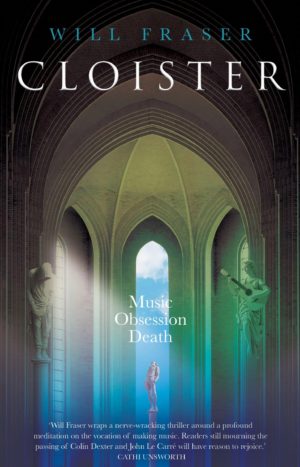
CLOISTER
A novel by Will Fraser
New Generation Publishing 2024
ISBN 978-1-83563-526-1 (Hardback) £18.99
ISBN 978-1-83563-527-8 (Paperback) £7.99
Hardback available in Fugue State Films shop
Paperback now available here and also on Amazon (Hardback and Kindle available now, paperback available after March 23rd)
Will Fraser founded Fugue State Films in 2007. He grew up in the west of England and the east of Canada. He was educated at three contrasting universities, Dalhousie in Canada, Cambridge in the UK, and the University of Mississippi in the USA. He is a musician, writer and film-maker. He has won awards for the classical music documentaries he makes through Fugue State Films, including BBC Music Magazine “best DVD” twice, and the Deutschenschallplattenkritikpreis three times.